There's a very interesting article in December 10, 2011 edition of The Economist about the effects of China's joining the World Trade Organization (WTO) ten years ago. While there are many critics that want to blame much of the United States' economic woes on China, the economic reforms which began 10 years ago have resulted in substantial changes in China's economy, many of which are beneficial to countries doing business with China.
To join the WTO, China has had to eliminate or limit thousands of tariffs and quotas restricting importation of foreign goods. Largely as a result, many foreign companies have developed profitable business relationships in China. Another WTO benefit for foreign businesses is that China publishes draft laws and allows 30 days for comment. Even if China doesn't respond to the comments, at least this gives foreign firms the opportunity to know what the rules are (although it is still often difficult to know when and to what extent rules will be enforced).
Academy Award winning actor Christian Bale has been stirring up some controversy in China and in the West recently. Bale stars in the Chinese film The Flowers of War (金陵十三钗) which was just released in Chinese movie theaters last week (and will have a limited theater release in the U.S. as well). The film's story takes place in 1937 in the Chinese city of Nanjing (formerly known as Nanking) which was invaded by Japan during the Sino-Japanese War.
In some Western media, Bale has been criticized for appearing in an allegedly Chinese propaganda-oriented film (for its anti-Japanese perspective). I haven't seen the film yet, but knowing about the historical events portrayed in the film, its certainly understandable for it to be anti-Japanese. Japanese soldiers committed massive atrocities including the rape, torture and murder of civilians which collectively became known as the Nanking Massacre or the Rape of Nanking. In the video clip below, Chinese director Zhang Yimou claims that The Flowers of War is not propaganda.
The Chinese film industry has been experiencing serious growth in recent years as new movie theaters are being built throughout much of the country and people are spending their hard-earned RMB on tickets. As 2011 draws to a close, it seems certain that box office revenue for the year will exceed U.S. $2 billion, the highest ever in China. China's year-end box office revenue in 2010 was $1.62 billion (RMB 10.2 billion). By early December, 2011 revenues were over $1.89 billion) and there are several new Chinese and foreign blockbusters debuting in theaters which virtually guarantees that the $2 billion milestone will be reached. The Flowers of War, a late 2011 release produced by Zhang Yimou and starring Academy Award winner Christian Bale is likely to significantly increase December 2011 box office revenues.
![]() |
I just returned yesterday from a trip to Wuyi Mountains (武夷山) that the Fujian provincial government held for foreign teachers working at universities in Fujian (福建). This trip was very well organized and, in addition to a meeting, we got to hike Wuyi Mountain, take a river rafting cruise, see some music and dance performances by university students, learn all about the famous tea grown in the mountain area, and of course (albeit reluctantly) sing karaoke-style at banquet dinners (always mandatory in China).
However, one of the biggest highlights was a visit to a local kindergarten where the young students acted as guides (one for each of us) and others instructed us on the etiquette of serving tea. I was quite impressed with these kids and their tea pouring skills. If I was doing this, half of the hot water would probably end up on the table and I'd likely have first degree burns as souvenirs. Here's a slideshow of photos from the Kindergarten visit and I'll post some others from the trip in future.
For people that don't know much about China (and don't want to bother reading books, etc.), here's an animated video that gives a very good short summary. In just 10 minutes, the video manages to cover Chinese history, language, economy, food, traditions and culture. It even manages to mention some of the modern problems China is facing including the many contradictions, corruption, and the little emperor syndrome (resulting from China's one-child policy).
I came across a post on Xujun Eberlein's Inside-Out China blog which I think gives a great example of cheating in modern Chinese society. The post, entitled Who Is the Guilty Party?, is actually an English translation of a Chinese writer's description of a problem encounted when buying a house - the previous owner had been scamming the electricity company and the new owner found out that correcting the crime was much harder and more expensive than continuing it (even though the new owner wanted to do the right thing).
Of course, cheating in various forms exists almost everwhere in the world, but it does seem to be a very ingrained part of Chinese society. Maybe this is partly due the the fact that Chinese society, despite all its recent modernization, is still built on an ancient culture in which personal relationships (known as guanxi; 关系) take precedence over everything else. The ethical rule that stealing is wrong (and legal rule that follows from it) has little practical value in a society where you can get away with many things if you know the right person. The Western concept of the rule of law is a very alien concept to such a society. Whether its cheating on your electricity bill, cheating on college exams, buying and selling counterfeit products, illegally viewing and downloading music and movies or any number of other inethical and/or illegal behaviors, you do it as long as you can get away with it and because everyone else does it.
I'm probably a bit lucky working for a Chinese university, in that I'm insulated from a lot of the inethical situations I'd likely encounter and (like the poor homebuyer in the blog post's story) feel very uncomfortable with otherwise.
A Chinese court recently ruled against Apple Inc. in a dispute over the right to sell computer products bearing the name "iPad" in China. Apple had sued a Taiwan-based technology company, accusing it of infringing its trademark in the iPad name. According to the United States Code (and most countries' trademark laws), a trademark is "any word, name, symbol, or design, or any combination thereof, used in commerce to identify and distinguish the goods of one manufacturer or seller from those of another and to indicate the source of the goods." So, the name iPad for example, can be a trademark that identifies computers or computer-related devices.
If Apple is infringing Proview's trademark, it would not only be liable for monetary compensation, but would also be prohibited from using the name iPad in China. Apple would still be able to sell iPads, but would have to do so under a different name. If Proview's trademark claim is legitimate as it seems it may be, I suspect that rather than selling iPads under another name, Apple might ultimately agree to buy the rights to the iPad name from Proview. In fact, Apple previously bought rights from Proview to the iPad name in Taiwan and several other Asian countries in which Proview had registered the trademark, but this purchase did not seem to include mainland China. So it appears that Apple may have to pay big bucks to keep selling iPads as "iPads" in China.
Apple iPads already dominate the market for tablet PCs in China
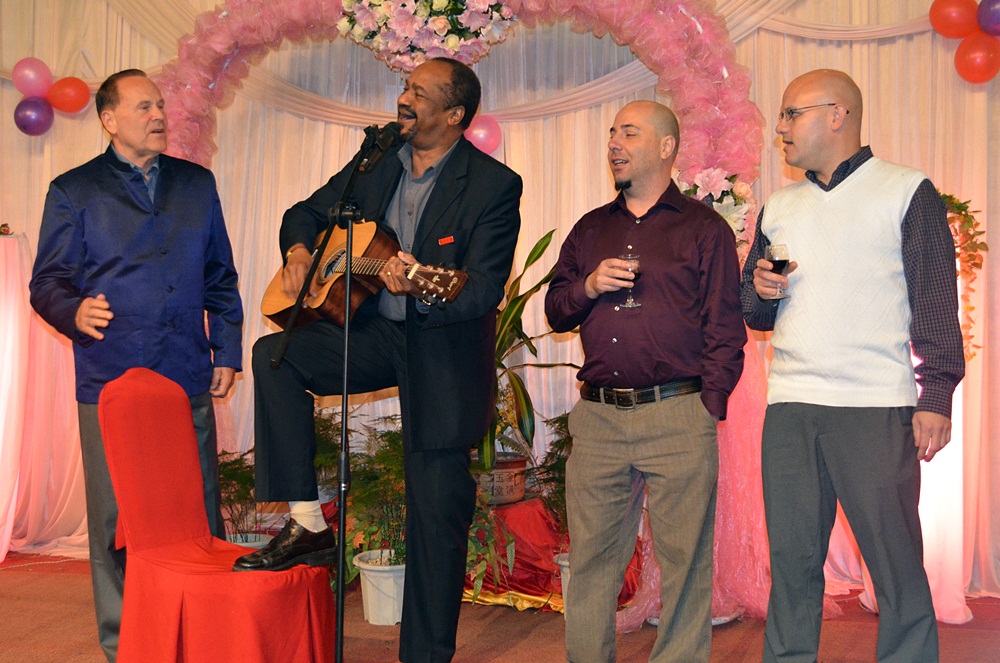
Last night, after spending the day at a conference at my university (Xiamen University of Technology; 厦门理工学院), I attended a dinner banquet at nearby Jimei University. The food was good, the wine was flowing freely, and (as always at any serious party in China) karaoke singing ruled the stage.
| The Xiamen Beatles |
![]() |
| Long Live Chairman Mao and John Denver in China! |
Designed by TumanoB. Converted to Blogger by Beta Templates.